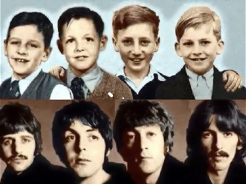
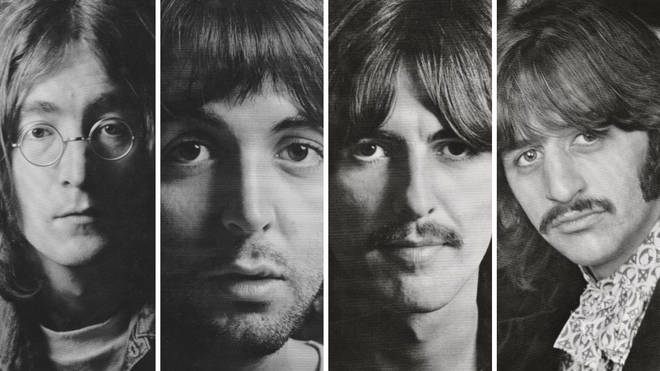
The Beatles first demonstrated self-alignment in their debut performance on The Ed Sullivan Show. The spectacle of the performance unleashed an unbridled reaction of unprecedented proportions. Emotions were unconstrained, logic was ignored while the first utterances of Beatlemania came from Paul when he sang, “Close your eyes and I’ll kiss you.” The lyrics to “All My Loving” were unfurled through radio airwaves for over three months by this time. Ringo’s constant swing-rhythm pulse on the hi-hat and John’s triplet strumming defied all previous pop song arrangements.
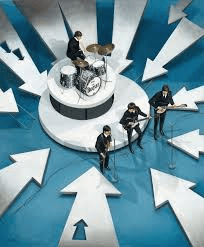
What do you see here??
The Beatles on their debut Ed Sullivan performance – February 9, 1964. Here was the merging of both communal and passionate traits and behaviors that changed popular thinking.
- A stage display of “phallic symbols” pointing to the group
- Four guys standing close to each other
- Physical communication
- Elevated drum set
- Camera close-ups of individual facial expressions
- Choreographed bow at the end of the song
Communal and Passionate traits and behaviors are necessary for success and well-being. Because of different societal structures, men required a modification of their behaviors in order to find their optimum standing for constant personal expansion.
The communal male was seen as a valued citizen who offered his communal camaraderie and loyalty for the economic benefit and physical well-being of the community at large. He was responsible for the public representation of his family which would assure the perpetuation of peace and stability. This first communal aspect is considered here as the most important with the discussion of The Beatles’ relationship with each other, as it became foundational to the overall, long-term strength and dynamism that secured the unity of their group through their challenges.
The passionate, “self-made” manhood revolution began to grow with the expanding industrialized society. Success for family stability was now incumbent on men’s abilities to compete with each other for employment suitable to their aptitude or talent. Men relied upon their personal preferences to direct them toward circumstances that appealed to them, inherently reflecting diversified personalities. This second, passionate manhood aspect is also germane to The Beatles’ relationship because the group was able to obey their personal ideas of expansion toward new creative territories fueled by their own creative preferences. These preferences are seen here as The Beatles’ aptitude for expressing their masculinity in leading edge compositional aspects and pioneering audio techniques. Male fans observed them both as a unit and individual personalities as The Beatles were diligent in sustaining their creative output, cognizant of the fact they were leaders of popular music. This required a consistent responsibility to sustain a fandom commitment that endured.
I’ve discerned this third manhood revolution to describe how The Beatles’ represented masculine characteristics of traits and behaviors that resulted in the launching of merged, self-identifying communal and passionate masculinities, labeled as self-alignment. The self-aligned perspective for The Beatles was not merely the simple summation of two manhood characteristics. The combination of the two cannot be supported on its own because they express cross-purposes. Merging communal and passionate traits and behaviors developed a larger self-aligned masculinity that is able to reconcile an antithetical combination into a new, all-encompassing expression.
Why is this important?
When both male and female fans realized how The Beatles accomplished a public display of this dichotomous combination of opposing traits and behaviors with a backdrop of hit pop songs, there was no stopping the momentum of The Beatles fandom movement. Though the girls caught media attention, male fans began in earnest to adopt for themselves The Beatles’ unorthodox masculinity regardless of their background or interests. Male fans understood they were justified to express themselves in the way they identified themselves to be. While girls screamed, boys climbed trees, jumped onstage, swam across canals, manufactured bootleg recordings or tearfully reacted, always demonstrating the extent of their feelings toward the group.
The Beatles were adept at modifying, altering and refining themselves to reconcile the contradiction of communal and passionate manhood expressions. The self-aligned containment of these traits was necessary for the group to remain as devoted to each other as possible, first through communal time then by expanding personal ideas through individual experiences and preferences in their passionate manhood years. When viewed from a self-aligned perspective, this secured their position as prominent musicians through social leadership in popular music, traits of advanced cultural thinking, empowerment behaviors, confident of themselves through self-awareness, dependability unto themselves and their responsibilities and a strong assertiveness that was expressed as a demanding attitude in the recording studio that was never misconstrued as arrogance by the men around them. These traits and behaviors became increasingly visible by 1966 and Sgt. Pepper’s Lonely Hearts Club Band when The Beatles’ self-aligned masculinity required a continued path toward the expansion for their creative ideas to become manifest in their songwriting and audio innovation. By insisting on the prompt materialization of their aural ideas from EMI engineers and producer George Martin, composers Lennon and McCartney were able to express their masculinity in their music as only they perceived it to be. It was understood that the group was fully aware of how the recording process would yield a self-aligned, gainful event for all involved.
The Beatles’ persona of a four-man communal unit that bonded with each other was their foundational strength. Traits of enduring loyalty, camaraderie, love and a primary sense of dedication to their survival superseded personal preferences. These preferences were not ignored, but welcomed since the group realized their self-aligned creative expansion required it. The group was well-aware of harnessing their communal energies to allow passionate preferences to unfold. A constant state of self-awareness was supported by a freedom-based philosophy that assured their expanding creativity was valid and accepted by their own standards which also did not seek the opinion of any other third party.
 Beatles Fandom