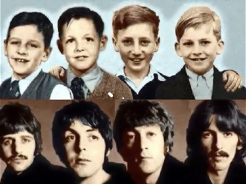
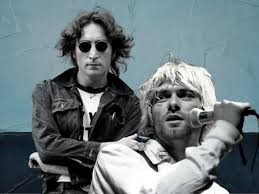
Kurt Cobain’s second-generation Beatles’ self-aligned fanship combined both heavy metal and punk that voiced with even greater insistence than his predecessors, that there was no need to defend personal masculine expressions with trendy costumes or other styles that did not represent an authentic self-representation.
His self-defined grunge genre may have had more to do with his keener critical thinking than musical distinctions as he assimilated and sifted through an extraordinary amount of music for his specific personal preferences that reflected his true masculine self-expression.
Second-generation Beatles fan Kurt Cobain is seen here as equally if not more self-aligned than his predecessors.
What’s alternative? What’s counterculture? What’s cool? Who knows? Who cares? If chasing cool is important to you, you’re an idiot!
Frances Cronin & Lauren Turner, “Six reasons why we still love Kurt Cobain,” BBC News, Entertainment, April 5, 2017, https://www.bbc.com/news/entertainment-arts-39005630.
The Beatles were the self-aligned result of successfully merging communal and passionate manhood traits and behaviors that eliminated purposeful rebellion in order to separate from outdated passionate-only manhood. First-generation heavy metal and punk – in Ozzy and The Ramones – attempted to further express The Beatles’ self-alignment into their own rock style by redefining them with an even stronger focus on their “self-awareness.” This resulted in a fan following that produced a trend of imitators in assorted sub-styles. As a result, rock music amounted to trajectories and sub-sets of future masculine identities not yet seen. Although this may have been necessary so that new masculine identities were secure and can proliferate, a second-generation Beatles fan was able to further define self-aligned traits and behaviors to expand his creative expression by eliminating the previous generation’s focus on securing any trend or following whatsoever.
This exposed an even stronger self-aligned masculinity in Kurt Cobain, who combined what was musically and visually comprised of heavy metal and punk. Cobain’s new genre, grunge, utilized what is seen here as the strongest of rock’s self-aligned trajectory from The Beatles’ influence and heritage. Cobain’s success supports how expanding self-aligned masculinity will continue to streamline a focus on the passionate self by eliminating an aspect from its predecessor. As The Beatles eliminated the notion of rebellion, and the first-generation fan eliminated the one-identity, multipurpose male, Cobain, reached the point where the consequence of his self-alignment was not only without rebellion but he also rejected associations with any previous trends that would justify his own masculine identity. He progressed his self-interests toward well-being on his own terms while having to override what had already been previously proven to be successful in rock music. Costumes or alter-egos were anathemas to his now further enlightened idea that disregarded everything that did not associate with self-alignment of communal and passionate traits and behaviors. Cobain’s quote above summarizes what grunge is, claiming it was no longer “cool” to follow someone else. Cobain’s authentic, self-aligned masculinity manner recognized this.
As a second-generation Beatles descendent, Cobain became the progeny of heavy metal and punk – a combination acknowledged by Cobain but he differentiates himself from his predecessors in two ways. First, Cobain distanced himself from Osbourne’s trend of other heavy metal bands and heavy metal culture and kept the loudly aggressive masculine aspect that appealed to him. He also did not support cultivating The Ramones’ fan following who dressed as punk. Cobain stated, “We’re so trendy we can’t even escape ourselves.” Secondly, drugs were also used by his predecessors for increased self-awareness, but Cobain eventually dismissed their function as well, although he was known for his history of abuse of heroin. Cobain had ultimately decided:
Drugs are a waste of time. They destroy your memory and your self-respect and everything that goes along with your self-esteem. They’re no good at all.
Kai Green, “Mind the 30th Anniversary of Nirvana’s Masterpiece Album Nevermind With These 60 Kurt Cobain Quotes,” Parade Pop Culture, September 24, 2021, https://parade.com/1267613/kaigreen/kurt-cobain-quotes/.
Cobain’s grunge simplified the essential styles of rock music:
First, it was The Beatles and then punk rock. That’s about it. When I was eight years old, I strapped a drum on with my dad’s tennis shoes, beat on the drum, and walked around the neighborhood singing Beatles songs.
The Grunge Scene, “Kurt Cobain on The Beatles,” Feb. 18, 2021, YouTube video, 5:01, https://www.youtube.com/watch?v=h15VNz-JXqk.
Finally, I got to hear Black Sabbath; you know the harder stuff they wouldn’t have played in Aberdeen or on the radio. So, I’m instantly a rock and roll fan – a harder rock and roll fan.
Ibid.
At a really early age I wanted to be a rock and roll star – I wanted to play drums ever since I got my first Beatles record, I wanted to play drums in a band. I wanted to have the adoration of John Lennon.
Jann S. Wenner, The Rolling Stone Interviews (New York, NY: Little, Brown and Company, 2007), 458.
Cobain related to Lennon’s masculinity, and it is considered that Cobain recognized Lennon’s communal leadership status in The Beatles, as well as the same passionately sensitive masculinity he felt of himself. Identifying with Lennon’s leadership qualities may have been Cobain’s attempt to imitate him on how that may have reproduced The Beatles’ level of success.
I remember John Lennon’s Imagine. I guess I’m twelve; that’s one of my first albums. That really set fire to me. It was like he was whispering in your ear – his ideas of what’s possible.
Ibid.
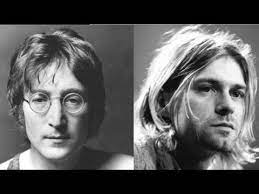
There seems to be a young communal manhood association with Lennon that marked Cobain’s awareness of himself and his evolving passionate masculine expressions of “what’s possible.” This may be seen as similar to Osbourne’s early passionate manhood predicament. However, it appears Cobain was well ahead of his years, at twelve, to observe himself and his personal passionate preferences. Identifying with Lennon may have provided him with the masculine communal trait of camaraderie that remained in his emotional view of himself as he matured. There remains a question here whether Cobain may have realized the extent of his quest to reach personal goals, and having done this so early, could he have decided that’s all he ever wanted out of life?
 Beatles Fandom
Leave a comment