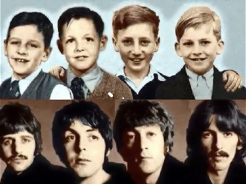
First-generation Beatles Boys Ozzy Osbourne, Gene Simmons and The Ramones, and many others have all stated they experienced a personal revelation to consider a career in music after watching The Beatles on the Sullivan show or just hearing a Beatles song on the radio. How did that happen? What was it about the Sullivan performance that compelled such a reaction? How could just a song change a life?
These Beatles Boys are discussed with a focus on their personal masculine identity – how they see themselves as men. They produced distinct and highly personalized personas. These famous male fans communicated The Beatles’ example of the allowance of expanded self-expression that validated their motivation to express themselves on their own terms. Their contributions positioned popular music on a central course toward an expanding trajectory of future interpretations of their style as well as sub-styles that were influenced by them. Not only did The Beatles help to entice their talent and determination that led to their own fame, but they also forged new trajectories in pop and rock music culture by conveying their unique masculine identities. As a result, these Beatles Boys helped to ensure The Beatles’ continued success and longevity.
Ozzy
Ozzy Osbourne was perhaps one of the least likely to become a famous musician – he did not play an instrument, was dyslexic, spent time in jail for robbery and worked at a slaughterhouse for eighteen months. However, he co-founded the heavy metal rock subgenre. He did not see the Sullivan telecast, but only heard one song, “She Loves You,” on a transistor radio. Osbourne even fantasized about becoming McCartney’s brother-in-law, pondering this image as his future lifestyle or way out of his stalled life. One could argue that Osbourne’s masculinity – how he understood himself as a man – was aligned with how he perceived McCartney’s masculinity. Osbourne prefigured a brotherly association with McCartney and established an emotional, communal manhood connection. The camaraderie in his own mind was extreme and its brotherhood aspect was self-evident and strong enough to be carried forward for many years until Osbourne found success. Osbourne translated his masculine identity’s rock genre into a dark, thunderous sound with a virtuosic guitar style and lyrics that reflect his heavy metal masculine expression.
Osbourne confessed to a moment of clarity in his life when he heard “She Loves You:”
That song changed my life. It had such an impact on me. Nothing really happened to me in my life until The Beatles happened and then it was like someone turned the world on for me. I remember exactly where I was. I had a blue transistor radio and when that song came on. I remember thinking to myself, fuck you know, incredible. From that moment I first heard “She Loves You” I knew I wanted to be a rock star for the rest of my life.
Sandy, “Ozzy Hears Beatles for the First Time,” September 2, 2012, YouTube video, 1:26, https://www.youtube.com/watch?v=XhIhPvIsdzM.
I knew from then on what I wanted to do with my life. It gave me this great feeling. Can you imagine going to bed one night and waking up to a completely exciting brand new world?
Ozzy Osbourne, “Ozzy Osbourne – End The Silence Music Memory,” YouTube video, 2:00, n.d. Accessed October 12, 2022, https://www.youtube.com/watch?v=
nb5E4TKLNVA.
Ozzy understood the value of merging communal traits of camaraderie with personal, passionate preferences that reflected how he perceived himself. These aspects were successfully merged to form his self-aligned masculinity. In one interview, Ozzy was quick to settle a misrepresentation that Lennon was “emotionally compromised” by making a strong communal reference of loyalty to him:
Everyone in the world has a skeleton in the cupboard. Everyone has something to hide and it’s nobody’s business. Why shatter people’s illusions, why shatter people’s dreams? To me he was one of the greatest men to walk this earth and he was a god to me. He gave me so much joy and inspiration and love and care, and everything you’d ever want out of somebody. There’s enough bad in the world. It makes my day easier to know Jesus was a good guy, that Lennon was a good guy.
Nathan Elena, “Ozzy Osbourne defends John Lennon’s reputation and says He was a God to me,” August 4, 2017, YouTube video, 4:01, https://www.youtube.com/watch?v=
_7RArw4dOSk.kiss.
Although it took forty years, Ozzy finally met McCartney along with filmmaker Albert Maysles, also present in the room. Of course Ozzy knew who Albert was, and in his eager, slightly clumsy fanship way, wanted to prove it by saying he possessed all of Maysles’ work:
“I have everything…!”
Hezakaya Starr, “Paul McCartney Meets Ozzy Osbourne,” September 28, 2014, YouTube video, 1:55, https://www.youtube.com/watch?v=AuV0GVVGlCw&t=1s and Appendix 2.
What he said to McCartney seems to have been rehearsed after all these years.
It’s great to meet you. It’s an experience of a lifetime and a great ambition of mine. You guys made me start music, you know.
Ibid.
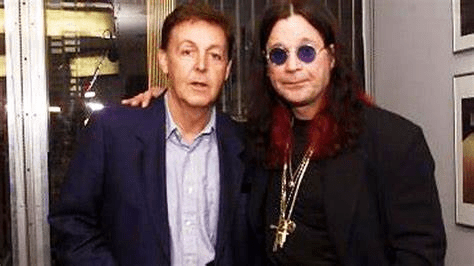
We are all fortunate to learn that Ozzy expressed his personal preferences for himself and his future successful life, filling his legacy with millions of his own fans who identified with him.
This is self-alignment’s purpose of the “gainful event” for all who recognize it – providing for the communal well-being of all through the personal passionate expressions of one. Even guitarist Hetfield from second-generation thrash metal Metallica later realized that Osbourne possessed a softer masculine side that he understood came from The Beatles. In 2014, Hetfield performed a solo, acoustic version of “In My Life.”
For more on Ozzy, see: Sounds of Masculinity: Male Fandom and The Beatles’ Glory
The Ramones
The Ramones all originate from Forest Hills. The kids there grow up either as musicians, degenerates or dentists. The Ramones are a little of each, their sound not unlike a fast drill on a rear molar – letter to A&R men from the Ramones.
Edward Helmore, “They wanted to be as big as the Beatles’: revisiting the Ramones’ legacy,” The Guardian, April 8, 2016, https://the guardian.com/music/2016/apr/08/the-ramones-legacy-queens-museum-new-york-exhibit.
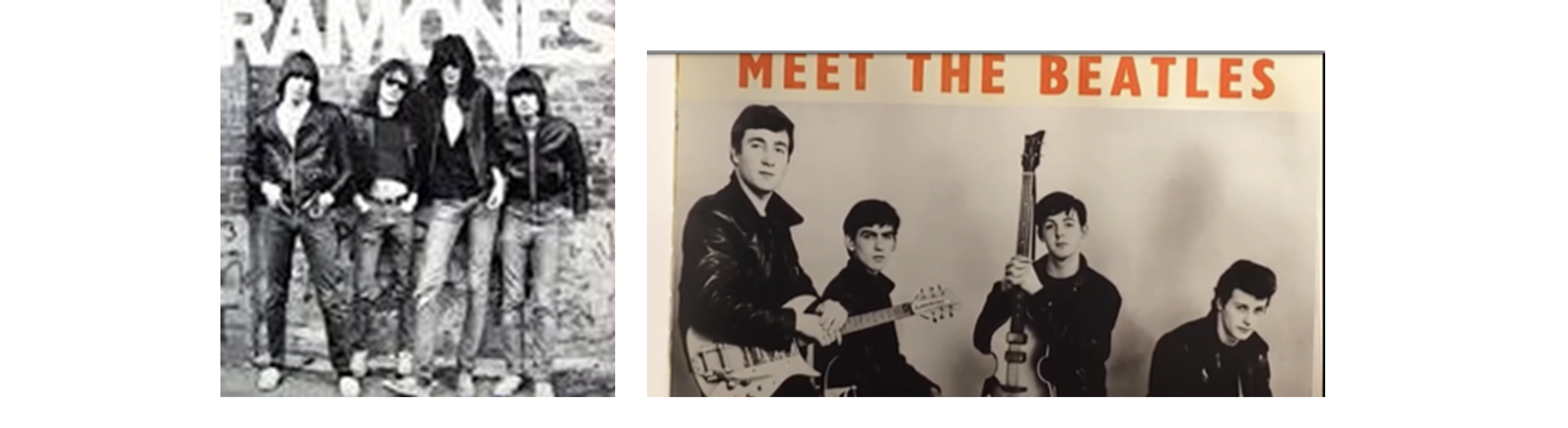
The Ramones re-invented The Beatles’ early sound into punk, which was the continuance of the Beatles’ generation’s view of self-alignment. But stronger attempts were made to express an intensified, musical version of passionate manhood preferences that differentiated themselves from their predecessors. The Ramones were intentional in their style but it did not appear arranged on the stage – opposite to what The Beatles choreographed for themselves. When the pre-Beatles were called The Quarrymen with drummer Pete Best, they were a raucous, disorganized, twelve-bar blues rock band. The Ramones appear to refine The Quarrymen’s expressions through a harder sounding, down stroke-only guitar strumming with an increased rock tempo of 177 bpm and seemingly purposeful anti-intellectual lyrics in a two-minute rock song. The Ramones also retained the Quarrymen’s attire and behavioral appearance of strong communal camaraderie, loyalty and respect for fans who could relate to mainstream’s view of them as deviants or outcasts – maybe not unlike what The Beatles represented to the previous generation of that time.
Punk allowed the outlier rock fan of The Ramones to find an association with their masculine identity and commercial sub-rock punk culture which by definition, implies a petty gangster or hoodlum. And as a gang – communal and passionate in its own right – all the group members exchanged their last name for Ramone, taken from Paul McCartney’s pseudonym when he checked into hotels as Paul Ramon. Dee Dee Ramone revealed how hearing The Beatles was a defining moment for him:
I couldn’t see a future for myself then I heard the Beatles for the first time. I got my first transistor radio, a Beatle haircut and a Beatle suit. Rock and roll gave me a sense of my own identity.
The Sound.com., “5 heavily Beatles-influenced bands from the 70s,” The Sound, https://www.thesound.co.nz/home/music/2020/12/5-heavily-beatles-influenced-bands-from-the-70s.html.
Dee Dee’s interpretation of The Beatles’ performance evinced in him the reality to pursue his music career and a future for himself, using his own self-aware “identity” to explain his purpose to emulate what he experienced when he heard The Beatles.
Joey Ramone’s identity as a punk rocker is his masculine, self-aligned reflection that includes the benefit of the community at large – a significant aspect of punk’s intentions.
To me, punk is about being an individual and going against the grain and standing up and saying, ‘This is who I am.’ To me, John Lennon and Elvis Presley were punks because they made music that evoked those emotions in people. And as long as people are making music that does that, punk rock is alive and well.
Joseph M. Turrini, “Well I Don’t Care About History: Oral History and the Making of Collective Memory in Punk Rock,” Notes, 70, 1, 2013, 59-77.http://www.jstor.org/stable/43672697.
Through their new rock style expressions, The Ramones reclaimed what they saw in The Beatles’ nascent, gang-like masculinity and offered it back in another small, camaraderie-based unit. A representation of the stripped-down, pre-Epstein Beatles look translated The Ramones’ primal, masculine communal traits of solidarity to explain the punk style.
With The Ramones’ keen communal sense and passionate preferences that ignored any third-party opinion, they offered another passionate manhood vision and a new genre of rock to a second-generation Beatles fan who claimed both the harder rock sound with a punk attitude.
Kurt
Second-generation Beatles fan Kurt Cobain is seen here as equally if not more self-aligned than his predecessors.
What’s alternative? What’s counterculture? What’s cool? Who knows? Who cares? If chasing cool is important to you, you’re an idiot!
Frances Cronin & Lauren Turner, “Six reasons why we still love Kurt Cobain,” BBC News, Entertainment, April 5, 2017, https://www.bbc.com/news/entertainment-arts-39005630.
The Beatles were the self-aligned result of successfully merging communal and passionate manhood traits and behaviors that eliminated purposeful rebellion in order to separate from outdated passionate-only manhood. First-generation heavy metal and punk – in Ozzy and The Ramones – attempted to further express The Beatles’ self-alignment into their own rock style by redefining them with an even stronger focus on their “self-awareness.” This resulted in a fan following that produced a trend of imitators in assorted sub-styles. As a result, rock music amounted to trajectories and sub-sets of future masculine identities not yet seen. Although this may have been necessary so that new masculine identities were secure and can proliferate, a second-generation Beatles fan was able to further define self-aligned traits and behaviors to expand his creative expression by eliminating the previous generation’s focus on securing any trend or following whatsoever.
This exposed an even stronger self-aligned masculinity in Kurt Cobain, who combined what was musically and visually comprised of heavy metal and punk. Cobain’s new genre, grunge, utilized what is seen here as the strongest of rock’s self-aligned trajectory from The Beatles’ influence and heritage. Cobain’s success supports how expanding self-aligned masculinity will continue to streamline a focus on the passionate self by eliminating an aspect from its predecessor. As The Beatles eliminated the notion of rebellion, and the first-generation fan eliminated the one-identity, multipurpose male, Cobain, reached the point where the consequence of his self-alignment was not only without rebellion but he also rejected associations with any previous trends that would justify his own masculine identity. He progressed his self-interests toward well-being on his own terms while having to override what had already been previously proven to be successful in rock music. Costumes or alter-egos were anathemas to his now further enlightened idea that disregarded everything that did not associate with self-alignment of communal and passionate traits and behaviors. Cobain’s quote above summarizes what grunge is, claiming it was no longer “cool” to follow someone else. Cobain’s authentic, self-aligned masculinity manner recognized this.
As a second-generation Beatles descendent, Cobain became the progeny of heavy metal and punk – a combination acknowledged by Cobain but he differentiates himself from his predecessors in two ways. First, Cobain distanced himself from Osbourne’s trend of other heavy metal bands and heavy metal culture and kept the loudly aggressive masculine aspect that appealed to him. He also did not support cultivating The Ramones’ fan following who dressed as punk. Cobain stated, “We’re so trendy we can’t even escape ourselves.” Secondly, drugs were also used by his predecessors for increased self-awareness, but Cobain eventually dismissed their function as well, although he was known for his history of abuse of heroin. Cobain had ultimately decided:
Drugs are a waste of time. They destroy your memory and your self-respect and everything that goes along with your self-esteem. They’re no good at all.
Kai Green, “Mind the 30th Anniversary of Nirvana’s Masterpiece Album Nevermind With These 60 Kurt Cobain Quotes,” Parade Pop Culture, September 24, 2021, https://parade.com/1267613/kaigreen/kurt-cobain-quotes/.
Cobain’s grunge simplified the essential styles of rock music:
First, it was The Beatles and then punk rock. That’s about it. When I was eight years old, I strapped a drum on with my dad’s tennis shoes, beat on the drum, and walked around the neighborhood singing Beatles songs.
The Grunge Scene, “Kurt Cobain on The Beatles,” Feb. 18, 2021, YouTube video, 5:01, https://www.youtube.com/watch?v=h15VNz-JXqk.
Finally, I got to hear Black Sabbath; you know the harder stuff they wouldn’t have played in Aberdeen or on the radio. So, I’m instantly a rock and roll fan – a harder rock and roll fan.
Ibid.
At a really early age I wanted to be a rock and roll star – I wanted to play drums ever since I got my first Beatles record, I wanted to play drums in a band. I wanted to have the adoration of John Lennon.
Jann S. Wenner, The Rolling Stone Interviews (New York, NY: Little, Brown and Company, 2007), 458.
Cobain related to Lennon’s masculinity, and it is considered that Cobain recognized Lennon’s communal leadership status in The Beatles, as well as the same passionately sensitive masculinity he felt of himself. Identifying with Lennon’s leadership qualities may have been Cobain’s attempt to imitate him on how that may have reproduced The Beatles’ level of success.
I remember John Lennon’s Imagine. I guess I’m twelve; that’s one of my first albums. That really set fire to me. It was like he was whispering in your ear – his ideas of what’s possible.
Ibid.
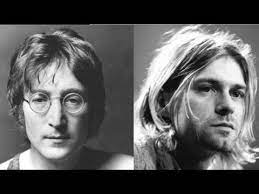
There seems to be a young communal manhood association with Lennon that marked Cobain’s awareness of himself and his evolving passionate masculine expressions of “what’s possible.” This may be seen as similar to Osbourne’s early passionate manhood predicament. However, it appears Cobain was well ahead of his years, at twelve, to observe himself and his personal passionate preferences. Identifying with Lennon may have provided him with the masculine communal trait of camaraderie that remained in his emotional view of himself as he matured. There remains a question here whether Cobain may have realized the extent of his quest to reach personal goals, and having done this so early, could he have decided that’s all he ever wanted out of life?
For more on Cobain and many other Beatles Boys, watch for: Sounds of Masculinity: Male Fandom and The Beatles’ Glory.
 Beatles Fandom