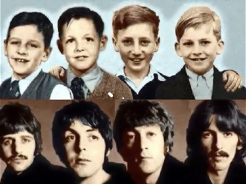
The Beatles became an incredible success story and their behavior showed an obvious contentment in that achievement. Not only because they were generating income for themselves and their record label, but because they understood the method by which to achieve that had everything to do with satisfying their personal, passionate expressions – and these expressions had everything to do with both new compositions and expanded audio techniques. Their self-aligned nature was already in place. They understood who they were and how they saw themselves as men. It would be seen that The Beatles’ future authority in the recording studio was unquestioned and accepted, as a result of their self-aligned manhood.
Not that they understood engineering or how to play other instruments besides their own. It was more specifically enhancing Lennon’s vocal and McCartney’s bass that produced a demanding behavior that allowed the fruition of their ideas to become manifest. Chief EMI engineer Ken Townsend realized how Lennon and McCartney’s behavior was ultimately correct. He understood that their experiences as self-aligned entrepreneurs had grown to such an extent that their requests for the sounds they wanted were in fact, demands and expected by the group to be fulfilled. Townsend invented a machine to help with Lennon’s constant complaining about the tediousness of performing double-track vocals. The Automatic Double Tracking device became an important addition to his engineering resume. Just another self-aligned gainful event!
In the early days, The Beatles too had to abide by the rules. But after they exploded onto the world stage, they were soon to change the role of the recording studio forever. They demanded that the studio be used as a workshop to contrive new sounds. They created open-ended studio hours, and they brought the best out of the engineers around them. The Beatles became too successful for anyone to doubt their wisdom. Others followed their work style and soon a flood of independent studios were being built to satisfy the demand.
Lewisohn, 204.
Townsend invented another machine, this time for McCartney. The masculinely descriptive DIT, or direct injection method, was used for his opening guitar riff on the title track of “Sgt. Pepper.” Townsend recalled:
I think direct injection was probably used on Beatles sessions for the first time anywhere in the world. We built our own transformer boxes, called DIT boxes and plugged the guitars straight into the equipment.
Lewisohn, 95.
Lennon was immediately supportive the DIT invention and, once again, demanded of George Martin he wanted it for his voice:
John came up to the control room one day and asked if we could possibly inject his voice directly into the console. Yes, if you go and have an operation. It means sticking a jack plug into your neck.
Ibid.
Another reaction to this new invention on McCartney’s guitar was quickly recognized by a famous Beatles male fan and rock guitar virtuoso, Jimi Hendrix. He noticed the hard-edged, opening guitar riff and decided to perform his rendition of it in his live performance only two days after Sgt. Pepper’s release. Male fans who were aware of Hendrix’ signature, peerless guitar performances will have surmised that he heard something distinct about McCartney’s guitar playing accomplished by Townsend’s new DIT audio enhancement. McCartney, who was in Hendrix’ audience, was thrilled to hear that Hendrix admired his opening riff and solo from The Beatles’ new album. McCartney continues to repeat this story during his own tours:
It was one of the greatest honors of my career.
Charles R. Cross, Room Full of Mirrors: A Biography of Jimi Hendrix, 252.
Author Ian MacDonald commented on Lennon and McCartney’s collaborative approach:
Lennon rarely bothered to learn any instruments properly, always wanting to move straight to expressing himself. More studious than his partner, McCartney nonetheless showed the same impatience, growing testy if any delay occurred in the rigging up the new recording effects he and his colleagues constantly demanded. If an arrangement of an unusual instrument or an entire orchestra was needed, The Beatles expected it to be there immediately. Waiting killed the spontaneity they so prized, taking them back into the patient, postponed slow world of their parents
Ian McDonald, Revolution in the Head, 22.
Lennon and McCartney showed the usual impatience with parents’ timing. Not only was their spontaneity seen as a reflection of self-alignment’s strong self-assertiveness for satisfying results by bringing ideas forward more rapidly, but it also produced number-one hit records. Since 1959, Lennon and McCartney normally sat across from each other for a songwriting session and a song was oftentimes accomplished in two or three hours. With contractual responsibilities to EMI, they were able to continue their collaborative routine, mindful of the pressure to complete material on time within their non-stop touring schedule. “From Me to You” was written in roughly two and a half hours on a coach, traveling from York to Shrewsbury during the Helen Shapiro tour. The song went on to become The Beatles’ first single to reach the number one chart position in the UK.
Readers here are aware of The Beatles’ innovative recording techniques and compositional experiments, so listing them may not add anything new to the discussion. From the first real attempts heard in Rubber Soul to the LSD-inspired Revolver and the revolutionary concept album in Sgt. Pepper’s Lonely Hearts Club Band and beyond, the list is extraordinary. In all cases, their ideas were accepted and implemented. Martin, Emerick and others fulfilled whatever requirement Lennon and McCartney made on them as the recording studio was a haven for a self-aligned gathering for all who pursued success and well-being.
 Beatles Fandom
Leave a comment