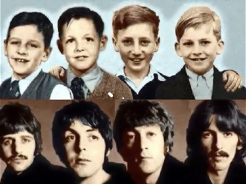
First-generation Beatles Boys Ozzy Osbourne, The Ramones, Billy Joel, Gene Simmons and many others have stated they experienced a personal revelation to consider a career in music after watching The Beatles on the Sullivan show or just hearing a Beatles song on the radio. How did that happen? What was it about the Sullivan performance that compelled such a reaction? How could just a song change a life? Second-generation Kurt Cobain is seen here as even more pronounced in his awareness of himself and his self-alignment when it is considered how he found his life’s calling to create another rock genre. What was it that he saw and heard to make him feel that way?
These Beatles Boys are discussed with a focus on their personal masculine identity – how they see themselves as men. They produced distinct and highly personalized personas. These famous male fans communicated The Beatles’ example of the allowance of expanded self-expression that validated their motivation to express themselves on their own terms. Their contributions positioned popular music on a central course toward an expanding trajectory of future interpretations of their style as well as sub-styles that were influenced by them. Not only did The Beatles help to entice their talent and determination that led to their own fame, but they also forged new trajectories in pop and rock music culture by conveying their unique masculine identities. As a result, these Beatles Boys helped to ensure The Beatles’ continued success and longevity.
Ozzy
Ozzy Osbourne was perhaps one of the least likely to become a famous musician – he did not play an instrument, was dyslexic, spent time in jail for robbery and worked at a slaughterhouse for eighteen months. However, he co-founded the heavy metal rock subgenre. He did not see the Sullivan telecast, but only heard one song, “She Loves You,” on a transistor radio. Osbourne even fantasized about becoming McCartney’s brother-in-law, pondering this image as his future lifestyle or way out of his stalled life. One could argue that Osbourne’s masculinity – how he understood himself as a man – was aligned with how he perceived McCartney’s masculinity. Osbourne prefigured a brotherly association with McCartney and established an emotional, communal manhood connection. The camaraderie in his own mind was extreme and its brotherhood aspect was self-evident and strong enough to be carried forward for many years until Osbourne found success. Osbourne translated his masculine identity’s rock genre into a dark, thunderous sound with a virtuosic guitar style and lyrics that reflect his heavy metal masculine expression.
Osbourne confessed to a moment of clarity in his life when he heard “She Loves You:”
That song changed my life. It had such an impact on me. Nothing really happened to me in my life until The Beatles happened and then it was like someone turned the world on for me. I remember exactly where I was. I had a blue transistor radio and when that song came on. I remember thinking to myself, fuck you know, incredible. From that moment I first heard “She Loves You” I knew I wanted to be a rock star for the rest of my life.
Sandy, “Ozzy Hears Beatles for the First Time,” September 2, 2012, YouTube video, 1:26, https://www.youtube.com/watch?v=XhIhPvIsdzM.
I knew from then on what I wanted to do with my life. It gave me this great feeling. Can you imagine going to bed one night and waking up to a completely exciting brand new world?
Ozzy Osbourne, “Ozzy Osbourne – End The Silence Music Memory,” YouTube video, 2:00, n.d. Accessed October 12, 2022, https://www.youtube.com/watch?v=
nb5E4TKLNVA.
Ozzy understood the value of merging communal traits of camaraderie with personal, passionate preferences that reflected how he perceived himself. These aspects were successfully merged to form his self-aligned masculinity. In one interview, Ozzy was quick to settle a misrepresentation that Lennon was “emotionally compromised” by making a strong communal reference of loyalty to him:
Everyone in the world has a skeleton in the cupboard. Everyone has something to hide and it’s nobody’s business. Why shatter people’s illusions, why shatter people’s dreams? To me he was one of the greatest men to walk this earth and he was a god to me. He gave me so much joy and inspiration and love and care, and everything you’d ever want out of somebody. There’s enough bad in the world. It makes my day easier to know Jesus was a good guy, that Lennon was a good guy.
Nathan Elena, “Ozzy Osbourne defends John Lennon’s reputation and says He was a God to me,” August 4, 2017, YouTube video, 4:01, https://www.youtube.com/watch?v=
_7RArw4dOSk.kiss.
Although it took forty years, Ozzy finally met McCartney along with filmmaker Albert Maysles, also present in the room. Of course Ozzy knew who Albert was, and in his eager, slightly clumsy fanship way, wanted to prove it by saying he possessed all of Maysles’ work:
“I have everything…!”
Hezakaya Starr, “Paul McCartney Meets Ozzy Osbourne,” September 28, 2014, YouTube video, 1:55, https://www.youtube.com/watch?v=AuV0GVVGlCw&t=1s and Appendix 2.
What he said to McCartney seems to have been rehearsed after all these years.
It’s great to meet you. It’s an experience of a lifetime and a great ambition of mine. You guys made me start music, you know.
Ibid.
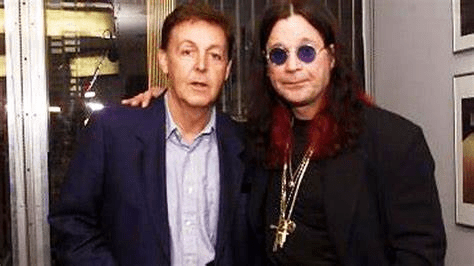
We are all fortunate to learn that Ozzy expressed his personal preferences for himself and his future successful life, filling his legacy with millions of his own fans who identified with him.
This is self-alignment’s purpose of the “gainful event” for all who recognize it – providing for the communal well-being of all through the personal passionate expressions of one. Even guitarist Hetfield from second-generation thrash metal Metallica later realized that Osbourne possessed a softer masculine side that he understood came from The Beatles. In 2014, Hetfield performed a solo, acoustic version of “In My Life.”
The Ramones
The Ramones all originate from Forest Hills. The kids there grow up either as musicians, degenerates or dentists. The Ramones are a little of each, their sound not unlike a fast drill on a rear molar – letter to A&R men from the Ramones.
Edward Helmore, “They wanted to be as big as the Beatles’: revisiting the Ramones’ legacy,” The Guardian, April 8, 2016, https://the guardian.com/music/2016/apr/08/the-ramones-legacy-queens-museum-new-york-exhibit.
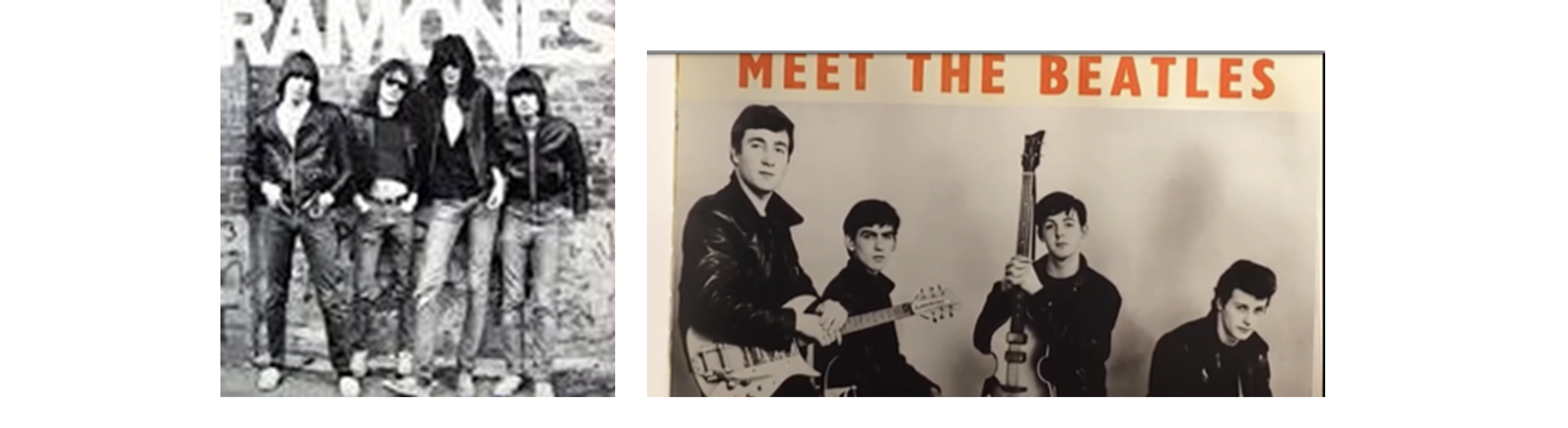
The Ramones re-invented The Beatles’ early sound into punk, which was the continuance of the Beatles’ generation’s view of self-alignment. But stronger attempts were made to express an intensified, musical version of passionate manhood preferences that differentiated themselves from their predecessors. The Ramones were intentional in their style but it did not appear arranged on the stage – opposite to what The Beatles choreographed for themselves. When the pre-Beatles were called The Quarrymen with drummer Pete Best, they were a raucous, disorganized, twelve-bar blues rock band. The Ramones appear to refine The Quarrymen’s expressions through a harder sounding, down stroke-only guitar strumming with an increased rock tempo of 177 bpm and seemingly purposeful anti-intellectual lyrics in a two-minute rock song. The Ramones also retained the Quarrymen’s attire and behavioral appearance of strong communal camaraderie, loyalty and respect for fans who could relate to mainstream’s view of them as deviants or outcasts – maybe not unlike what The Beatles represented to the previous generation of that time.
Punk allowed the outlier rock fan of The Ramones to find an association with their masculine identity and commercial sub-rock punk culture which by definition, implies a petty gangster or hoodlum. And as a gang – communal and passionate in its own right – all the group members exchanged their last name for Ramone, taken from Paul McCartney’s pseudonym when he checked into hotels as Paul Ramon. Dee Dee Ramone revealed how hearing The Beatles was a defining moment for him:
I couldn’t see a future for myself then I heard the Beatles for the first time. I got my first transistor radio, a Beatle haircut and a Beatle suit. Rock and roll gave me a sense of my own identity.
The Sound.com., “5 heavily Beatles-influenced bands from the 70s,” The Sound, https://www.thesound.co.nz/home/music/2020/12/5-heavily-beatles-influenced-bands-from-the-70s.html.
Dee Dee’s interpretation of The Beatles’ performance evinced in him the reality to pursue his music career and a future for himself, using his own self-aware “identity” to explain his purpose to emulate what he experienced when he heard The Beatles.
Joey Ramone’s identity as a punk rocker is his masculine, self-aligned reflection that includes the benefit of the community at large – a significant aspect of punk’s intentions.
To me, punk is about being an individual and going against the grain and standing up and saying, ‘This is who I am.’ To me, John Lennon and Elvis Presley were punks because they made music that evoked those emotions in people. And as long as people are making music that does that, punk rock is alive and well.
Joseph M. Turrini, “Well I Don’t Care About History: Oral History and the Making of Collective Memory in Punk Rock,” Notes, 70, 1, 2013, 59-77.http://www.jstor.org/stable/43672697.
Through their new rock style expressions, The Ramones reclaimed what they saw in The Beatles’ nascent, gang-like masculinity and offered it back in another small, camaraderie-based unit. A representation of the stripped-down, pre-Epstein Beatles look translated The Ramones’ primal, masculine communal traits of solidarity to explain the punk style.
With The Ramones’ keen communal sense and passionate preferences that ignored any third-party opinion, they offered another passionate manhood vision and a new genre of rock to a second-generation Beatles fan who claimed both the harder rock sound with a punk attitude.
Billy
Known as “The Piano Man,” the classically trained Joel was influenced by how he perceived The Beatles’ masculine bravado while they performed on the Ed Sullivan Show. He was fifteen years old and had finished most of his communal years, living through his parents’ divorce, while preparing to consider his future. How he saw himself and his masculine identity would have everything to do with his musical talent.
Joel came from a working-class community in Oyster Bay, Long Island in New York, that stressed a self-sufficient means by which to attain success in an otherwise underprivileged environment. Joel’s repertoire often associates with American working-class themes of struggle and a sense of boldness in an effort to sustain communal well-being through a strong sense of passionate masculine energy. It is considered here that Joel’s recognition of The Beatles and their background had much to do with his approach to his own abilities to success through his own songwriting and piano proficiency,
For this approach to occur, Joel had to realize the self-aligned presentation of The Beatles. Joel has said:
That one performance changed my life.
Jordan Potter, “Billy Joel picks out his favorite Paul McCartney song,” Far Out, August 13, 2022, https://faroutmagazine.co.uk/billy-favourite-paul-mccartney-song/.
You could see this look in John Lennon’s face, and he looked like he was always saying: fuck you! I said, I know these guys, I can relate to these guys, I am these guys. This is what I’m going to do — play in a rock band. Coming from my background I thought, so that’s possible – I can actually do that
Bill Crandall, “Ten musicians who saw the Beatles standing there,” CBS News, https://web.archive.org/web/20140207051338/http://www.cbsnews.com/news/10-musicians-who-saw-the-beatles-standing-there/.
Joel’s intuitive, masculine understanding of The Beatles perceived how their self-aligned traits and behaviors were going to be a positive influence on him. He immediately grasped The Beatles’ recipe of success that was made up of an oxymoronic combination of capitalistic expertise with anti-establishment ideas. This self-alignment meant there was well-being to be had without the opinion or permission of any third party.
Gene
There is no way I’d be doing what I do now if it wasn’t for the Beatles. I was watching The Ed Sullivan Show and I saw them. Those skinny little boys, kind of androgynous, with long hair like girls. It blew me away that these four boys – the middle of nowhere could make music.
My first thoughts about pop music were born that night, and they were simple thoughts: If I go and start a band, maybe the girls will scream for me
Ibid.
Simmons’ direct reference seeing The Beatles on the Sullivan show demonstrates the impact of both sight and sound on his immediate fanship. It is interesting that Simmons’ band KISS is known for extreme costume and make-up in its performance protocol, as if to eliminate any doubt over androgyny. There is a pronounced team-unit visual with KISS that leaves no doubt over their aggravated masculine identity. Here is the connection of Simmons’ band to the masculine communal acceptance he realized from The Beatles – a permission to exercise self-alignment by expressing a masculine identity without a third party opinion. KISS’ team unit appearance is the strongest symbol of masculine unity and their costume is an example of extreme passionate manhood preferences.
We wanted the entire band to sing, and we wanted everybody to write. We wanted everyone to be a star. We wanted to do it like The Beatles with a twist because we were taller and didn’t have those little-boy looks.
Gene Simmons, KISS and Make-Up, 73.
Lemmy
Kimilster’s strong sentiment about Lennon is notable, as it offers raw, emotional clarity:
John Lennon was my Savior. He was massive. The Beatles changed the world, you know. They really did. The generation which includes me, we believed we can make the world better, you know. And we failed because the world is so full of shit. You know the way the money works and you can’t fight money.
Rafael Porcaro, “What was Lemmy Kilmister’s opinion on The Beatles and John Lennon,” Rock and Roll Garage, September 2021, http://rockandrollgarage.com/what-was-lemmy-kilmister-opinion-on-the-beatles-and-john-lennon/.
Kimilster was one of the rare men who, like Osbourne, had no reservations over expressing himself about other men.
Motӧrhead was formed in 1975. The group is seen as a precursor to the newer wave of Britain’s heavy thrash metal – providing a strong example how Lemmy saw himself as a man and everything about his self-alignment. Between “making the world better” as a communal promise, along with “you can’t fight money,” as a passionate preference, Lemmy was one of Lennon’s strongest admirers.
Sting
Sting is clear about The Beatles’ influence upon him.
I’m a musician because of the Beatles.
Rob Laing, “Sting on the Beatles: They conquered the world with their own songs, and therefore gave permission to a younger generation to try the same thing,” Bitdefender, November 2021, https://www.musicradar.com/news/sting-beatles-paul-mccartney.
He recounts his introduction to The Beatles and finds an ongoing affinity and communal kinship with The Beatles from what he heard in the group’s music, interpreted through his own strong, early musical talent:
The first time I heard The Beatles would have been late 1962. I was 11 years old. On the radio a sound came through – a II with a IV bass, sad harmonica, this fantastic two-part harmony and this beautiful chorus and I realized after that everything was going to be completely different. I don’t know why. I could not articulate it at the time. I thought it was incredibly important and it changed my life. Those people of my generation were given permission to at least try to do what The Beatles did. And I’m eternally grateful. There is something in the driven and compulsive nature of this obsession that is unusual, something in the unconscious saying, this is how you escape. This is how you escape.
Promax, “#Because The Beatles: Sting’s Story,” October 18, 2016, YouTube video, 1:41, https://www.youtube.com/watch?v=Y9VN0FbwUlQ.
This is how you escape… Sting was confident in his understanding that The Beatles showed how self-alignment was the template to success and well-being. What is unique about Sting’s example is that he did not watch the Sullivan performance. Like Osbourne, a song was the driving force – his “obsession” that was finally unveiled for him.
Bruce
A song and a visual:
“I Want to Hold Your Hand” came on the radio in 1964. That was going to change my life because I was going to successfully pick up the guitar and learn how to play it.
Rolling Stone, “Bruce Springsteen on Hearing The Beatles, His First Band, and ‘Hungry Heart’ | The First Time,” YouTube video, 4:30, https://www.youtube.com/watch?v+7rARMfY8swU&t=89s.From over the sea, the gods returned, just in time. Ten thousand watts of high-voltage anticipation. Heart pounding for the first real look at my new saviors.
Bruce Springsteen, Born to Run, 50.For more of Beatles Boys, see: Sounds of Masculinity: Male Fandom and The Beatles’ Glory.
 Beatles Fandom
Leave a comment