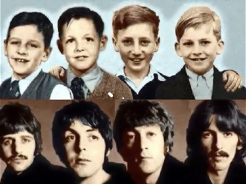
The four-month compulsory hiatus proved to be the pivotal event for The Beatles’ thriving future career as it enforced a “second-tier” communal manhood, the results of which revolutionized rock music’s recording standards. This second-tier communal experience is seen as a new personal self-awareness that disrupted their thinking of a consolidated Beatles identity and instead allowed for an increased, individualized masculine identity recalibration without the hindrance of career obligations. The success of their eventual reunion authenticates how their resilient, ever-present communal gang-like bonding was key. Despite the emotional estrangement, this time apart ultimately enriched merged communal and passionate manhood traits and behaviors that comprised their self-aligned perspectives. This fed their passionate personal preferences to an even greater extent as separate songwriting efforts of Lennon and McCartney and demands for new audio techniques in the recording studio were manifested from this interruption.
Lennon was the first to provide the thematic paradigm of hindsight – a reminiscing perspective that included hallucinatory experiences from the effects of his current use of marijuana and LSD. The newly adjusted, expanded creative attempts at composition and audio technology are termed here as psychedelic nostalgia, first observed with his song, “Strawberry Fields Forever.” McCartney followed by his concept album idea of Sgt. Pepper’s Lonely Hearts Club Band.
It was just a sort of freak show. The Beatles were the show and the music had nothing to do with it – Lennon
Stephanie Merry, “Ringo was the secret ingredient and other revelations from Ron Howard’s Beatles movie,” The Washington Post, Arts and Entertainment, September 16, 2016, https://www.washingtonpost.com/news/arts-and-entertainment/wp/2016/09/16/ringo-was-the-secret-ingredient-and-other-revelations-from-ron-howards-beatles-movie/.
[LSD] made us see life in a different light and touring was no longer fun – Harrison
The Beatles, Anthology, 239.
Lennon realized that The Beatles’ music was no longer important to fans and that the spectacle of The Beatles group was the attraction. Harrison realized in his expanded spiritual self-awareness that after experimenting with LSD, thoughts of public performances for the sake of being a member of The Beatles were no longer a goal. Both are valid reasons to quit the non-stop Beatles’ lifestyle. Moreover, they were personally compromised, exhausted and frustrated.
A four-month hiatus compelled The Beatles to devote their attention and time apart toward individual interests and new communal experiences alongside their expanding, self-aligned freedom-seeking masculinity. This was a second-tier communal manhood period that allowed for a retrospective of their earlier years while continued use of marijuana and LSD fueled future compositional and audio ideas that mimicked their drug-induced experiences.
Lennon exercised his newly expanded artistic motivation with acting and went to Almeria, Spain to play Musketeer Gripweed in How I Won the War, directed by Richard Lester who also directed the two Beatles’ feature films, A Hard Day’s Night (1964)and Help! (1965). Lennon found male camaraderie with other actors and reunited with former colleague, Lester. By traveling to Almeria, he separated himself from his wife and child, but he also found a second-tier level of his communal self in another new passionate experience. Working in a new location expanded his self-awareness to another communal manhood experience – one that would offer camaraderie and purpose for the well-being of the acting community. While there, he wrote the acoustic song, “Strawberry Fields.” Lennon expressed a keen level of self-aligned, self-awareness as he considered that a nostalgic visit into his early communal manhood was a useful idea for a song – one the required strong self-reflection, but interpreted in the hazy inconsistency of hallucinogenic images.
McCartney did not seem willing to suspend touring. It has been previously noted that of all the group members, he was consistently interested in maintaining The Beatles’ productivity regardless of any contrast to their plans. He had to be convinced by the other three members that touring needed to discontinue. McCartney was fully vested in perpetuating The Beatles’ fame. It appeared The Beatles were a non-stop communal male’s pursuit toward another passionate manhood experience. However, his second-tier communal manhood may have never been considered if it weren’t for the final, Candlestick Park performance. Still, the hiatus forced a physical detachment between himself and Lennon, temporarily straining his songwriting partnership opportunities. But maybe not so much, because:
Having the time off gave us a lot of freedom to come in with crazy ideas. As we were trying to get away from ourselves, how about we become an alter-ego band? Something like, say, “Sgt. Pepper’s Lonely Hearts?” I’ve got a little bit of a song cooking with that title. We would be Sgt. Pepper’s band, and for the whole of the album, we would pretend to be someone else
Ibid., 241.
McCartney is inclusive of all group members about his idea, except for his passionate strength in songwriting, where he easily takes full credit. McCartney conceived a nostalgic perspective of a vaudeville band immersed within hallucinatory images and sounds from his LSD experiences to create a unifying concept album that is seen here as a most apparent attempt at a second-tier communal manhood. Considering how McCartney’s drive for The Beatles’ continued work was analogous to his own self-aligned identity (and work ethic), and one not to be interrupted, he had no other means by which to involve the band while they were separated. He managed to discover an alternative path that could involve their second-tier communal expressions while benefitting the entire group community. Further, his idea may be more easily accepted by the others since the characters on the album were other people, or their alter-egos. His continued search for expansion of his self-aligned masculine identity as a leader in popular rock music culture compelled him to finalize his new concept album idea.
Harrison had been exhausted from touring and threatened to leave the band completely at least a year before the final concert. Brian Epstein assured him of no more touring, and Harrison remained in the band. He was able to experience his first feelings toward a second-tier communal nature in September 1966 when he decided to travel to India with his new wife, Patti Boyd. His personal preferences appeared to have been focused upon himself and a new family as his interest in The Beatles was waning. They remained in India for six weeks while Harrison studied the sitar and Hindu philosophy.
It was the first feeling I’d ever had of being liberated from being a Beatle or a number.
The Beatles Bible, “George and Pattie Harrison Travel to India,” September 11, 2018. https://www.beatlesbible.com/1966/09/14/george-pattie-harrison-travel-to-india.
Liberation equals expansion for the self-aligned and Harrison’s trip to India was his personal encounter with his second-tier communal manhood. But:
It was like a job, like doing something I really didn’t want to do. It felt like going backward. Everybody thought Sgt. Pepper was a revolutionary record, but for me, it was not enjoyable.
The Beatles, Anthology, 242.
It may be surmised that although Harrison did not fully participate in the LP’s recording, his continued search for self-aligned expansion in the most personal of communal expressions was of benefit to himself, The Beatles and to all other future communal fellowships with which he became professionally involved. Harrison’s decisions for himself and his family were correct for him. His expanding self-actualized awareness may also be seen as surpassing the others in the group – though not for their continued legacy, but for the greater loyalty to himself.
Starr’s second-tier communal manhood period was, like Harrison’s, underway before the Candlestick Park performance. Starr had married in February 1965 to Maureen Cox and became a father by September of that year. Deciding not to tour did not interrupt his communal manhood plans for himself. Starr found his second-tier communal male revisited in a strong way and was happy to live his life with his new family.
I really enjoyed having time off in 1966, getting used to the idea. ‘OK that’s it for touring – let’s have fun with my wife and child.’ I now had time to do other things.
Ibid., 231.
Starr also reached out to Lennon when he was filming in Spain.
Toward the end of 1966, with John being in Spain filming How I Won the War, I went and hung out with him because he was lonely. We really supported each other a lot.
Ibid.
McCartney’s idea to side-step The Beatles’ own personalities and transfer them into aliases within the concept album idea, worked to not only release the burden of transcending their past efforts in the usual way, but like the self-alignment view of the prior generation’s rebellion, the idea was instead to eliminate it completely and substitute a new standard. This freed the need for any prerequisite criteria and instead, allowed The Beatles to embark on a new trajectory whose materialization was improvised from beginning to end. Therein was the necessity – again – for the implementation of spontaneous ideas.
The results of these progressively complicated innovative ideas by Lennon and McCartney were accomplished through their self-aligned leadership traits and behaviors such as risk-taking, confidence, self-sufficiency and focus which were recognized by EMI engineers and Martin as an authentic representation of their masculine character. For all involved, it appears they were certain that the implementation of personal preferences reflected their masculine traits of individualism and self-sufficiency that satisfied both their personal ideas to expand in their talents and expertise. In this way, The Beatles increased their success and continued their legacy as their masculine identity as leaders in the pop/rock recording industry continued to be maintained.
Nice way to spend your time off.
For more Hiatus, see the upcoming, Sounds of Masculinity: Male Fandom and The Beatles’ Glory.
 Beatles Fandom
Leave a comment